carsparefinder.co.uk
  • About

Brakes

From simple mechanical friction to smart systems that can stop your car before you even react, brake system evolution is one of the most underrated stories in motoring history.

From Drum Brakes to Disc Brakes: The First Revolution

It all started with drum brakes, invented by Louis Renault in 1902. The design was elegantly simple — a set of friction shoes expanded outward against the inside of a rotating drum attached to the wheel hub. For decades, this was the industry standard, and you’ll still find drum brakes on the rear axle of many budget and mid-range cars today, where braking loads are lighter.

The real game-changer came with disc brakes in the 1950s and 60s, migrating from motorsport into everyday road cars. A caliper squeezes brake pads against a spinning disc (rotor), and the results are significantly better — improved heat dissipation, stronger wet-weather performance, and easier servicing. Most modern cars run disc brakes on all four wheels, with front discs doing roughly 70–80% of the stopping work.

The Material Difference: Cast Iron, Ceramic, and Carbon

The materials inside your brakes have changed just as dramatically as the designs. Cast iron remains the backbone of conventional brake discs, prized for its durability and cost-effectiveness. Grey cast iron (GCI) discs typically contain 2.5–4% carbon and 1–3% silicon, with the graphite structure helping to conduct heat away from the friction surface. High-carbon variants (3.6–3.9% carbon) offer improved crack resistance and quieter operation — you’ll often see these specified as OEM fitments on premium models.

Brake pads have undergone their own transformation. Early pads were asbestos-based. By the mid-1980s, ceramic brake pads arrived — made from dense ceramic fibres bonded with fine copper filaments — offering quieter stops, less brake dust, and longer service life compared to semi-metallic alternatives. For everyday driving, ceramic pads are now the go-to recommendation.

At the top end, carbon-ceramic composite rotors — constructed from carbon fibre-reinforced silicon carbide (C/SiC) — deliver extraordinary heat tolerance and weigh far less than cast iron. The trade-off? A cost premium exceeding 10x that of a conventional cast iron rotor, which is why they remain the preserve of high-performance and supercar applications.

Era System Key Material Notable Feature
Early 1900s Drum brakes Steel/cast iron shoes First reliable stopping mechanism
1950s–60s Disc brakes Grey cast iron GCI rotors Better heat dissipation, motorsport origin
1970s–80s ABS introduced Cast iron + hydraulic electronics Prevented wheel lock-up
1980s–90s Ceramic brake pads C/SiC ceramic composite Quieter, less dust, longer-lasting
2000s–2010s EBD, Brake Assist Multi-sensor electronics Optimised force per wheel
2020s+ AEB, Regenerative Carbon-ceramic, smart sensors Predictive, self-monitoring systems

The Electronics Revolution: ABS, EBD, and Beyond

The 1970s brought arguably the biggest single leap in brake safety — Anti-lock Braking System (ABS). By using wheel-speed sensors to detect an impending lock-up and rapidly modulating hydraulic pressure, ABS lets you steer while braking hard — something previously impossible. It’s now standard on every new car sold in the UK and EU.

Building on ABS, Electronic Brake-force Distribution (EBD) arrived to intelligently vary braking force between individual wheels depending on load and road conditions. Follow that with Brake Assist (BAS), which recognises a panic stop and applies full braking force faster than most drivers physically can — and you start to see how much silent technology is operating on your behalf.

Smart Brakes and the Road Ahead

Today’s most advanced vehicles feature Autonomous Emergency Braking (AEB), which uses cameras and radar to detect an imminent collision and intervene automatically. In testing, integrated braking systems can halt a car travelling at 60 mph up to 10 yards sooner than a conventional vacuum-based setup — a margin that genuinely saves lives.

Then there’s regenerative braking — the system in hybrids and EVs that recaptures kinetic energy during deceleration and feeds it back into the battery. It reduces wear on physical pads and discs, extends range, and is only going to become more refined as electric vehicles dominate the market.

Brakes

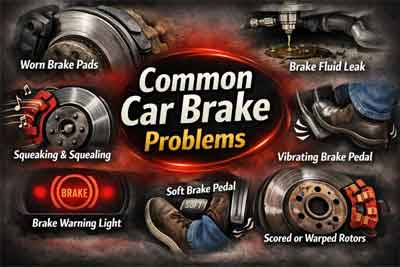
5 Common Car Brake Problems

5 Common Brake Problems Our brakes are maybe the most important thing to keep tabs on. Of course if your engine isn’t working it won’t run. If your wheels are off kilter than it won’t go either. But if your brakes don’t work then even if all those other things are running Read more

By admin, 5 yearsDecember 11, 2020 ago

All Content Is For Reference Purposes Only: Please Seek Professional Advice Before Starting Any Work On Your Vehicle!


  • About
Hestia | Developed by ThemeIsle
