
The Truth About the Ford Focus Starter Motor
We've all been there. You turn the key, and instead of the reassuring purr of your engine, you're met with a single, sad click. Or worse, silence. If you drive a Ford Focus, a faulty starter motor is a likely culprit. But before you rush out to buy a replacement, it pays to understand exactly what you're dealing with. The starter motor scene for the Focus is more dynamic than you might think, with variations across generations and a few hidden traps that could catch you out – and your wallet.
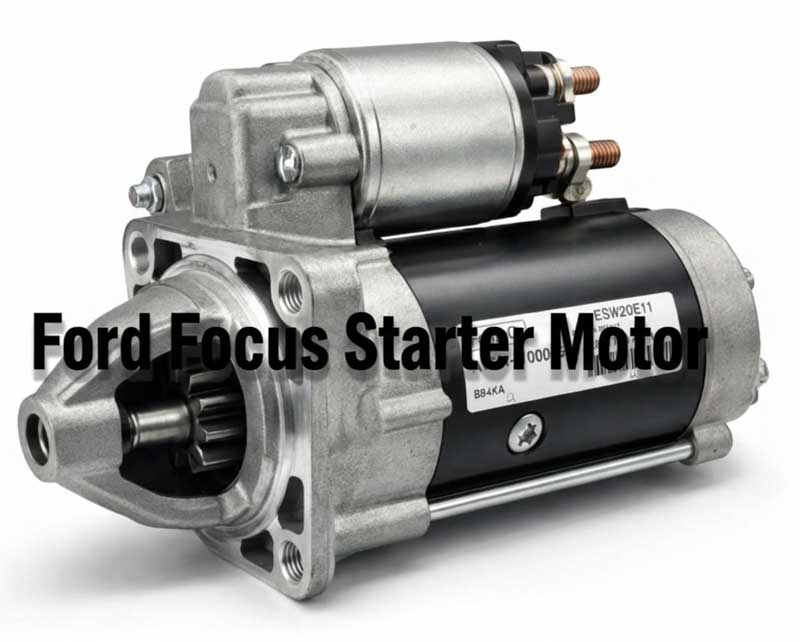
It's Not Always the Starter's Fault
First, let's talk about the elephant in the room. If your starter motor has failed, particularly on a diesel model, the component itself might be the victim, not the cause. According to industry experts at Autoelectro, there is a common problem on this application where the Dual Mass Flywheel (DMF) breaks up . This sends metal filings and a grey powdery substance into the starter motor, causing it to jam and fail. Forum discussions echo this, with experienced mechanics noting that a knackered DMF filling the starter with swarf is a frequent issue on TDCi models .
This is a crucial insight. If you simply bolt on a new starter without inspecting the flywheel, you'll likely be replacing it again very soon. In fact, Autoelectro explicitly states that failure due to DMF issues is not covered under warranty . So, if your mechanic pulls out an old starter covered in metallic dust, you know the real battle is with the flywheel – a four-figure job if done properly, including a new DMF, clutch, and starter .
A Tale of Two Starters: Petrol vs. Diesel
When you start looking for a replacement, you'll quickly notice that not all Focus starters are created equal. The most significant divide is between petrol and diesel engines, which require different power ratings.
For instance, a common replacement for a petrol Ford Focus or C-Max is a unit with a 1.4 kW power rating. You'll often see these listed with OEM numbers like 0001108408 or 1570611, which are crucial for ensuring you get the right fit . These typically feature 9 teeth and spin clockwise. A brand new unit from a specialist like ASL will set you back around £182 .
However, step up to a diesel, and the game changes. A starter for a 1.6 or 2.0 TDCI diesel needs significantly more grunt to turn over a high-compression engine. A unit like the Apec ASM1256, which also fits the Focus, C-Max, and Mondeo, boasts a much heftier 2 kW rating . This extra power is non-negotiable for diesel engines, especially in colder weather. This 2kW unit is available for around £100 from online retailers .
To give you a clearer picture, here's how a couple of real-world UK options compare:
As the table shows, if you have a standard petrol Focus used for daily commuting, a quality replacement with the correct OEM number is essential . But interestingly, you might find a used unit from a breaker's yard for as little as £18 (excluding delivery), offering a budget-friendly stop-gap . For diesel owners, the 2kW rating is the critical number to look for.
How to Remove a Ford Focus Mk3 Starter Motor: A Saturday Afternoon Adventure
So, you’ve turned the key one too many times and been greeted by that dreaded single click. Or maybe just a sluggish, groaning sound that screams "I don't want to get up today." You've done your homework, you suspect the starter motor is the culprit, and now you're staring at your Ford Focus Mk3 (2011-2018) wondering if this is a job for you or a job for the local garage.
I’ve got good news and bad news. The bad news? The starter motor on a Mk3 Focus isn't sitting right on top, waving at you. The good news? With a bit of patience, the right tools, and a cuppa nearby, it is a job you can absolutely tackle at home. It’s one of those perfect weekend tasks that saves you a bundle on labour and gives you that satisfying feeling of "I fixed that myself."
But here's the thing about the Mk3: it's a bit of a Jekyll and Hyde. Depending on whether you have a petrol or a diesel engine, your experience will be completely different. One involves contorting yourself under the dashboard, the other involves playing mechanic in the engine bay. Let's break it down so you know exactly what you're getting into.
The Great Divide: Petrol vs. Diesel Access
Before you even pick up a spanner, you need to know where your particular starter motor lives. If you pop the bonnet and start poking around the engine bay on a petrol model, you'll be searching for hours because you're looking in the wrong place.
On the Ford Focus Mk3 (2011-2018) , the location is dictated by fuel type:
- Petrol Models: The starter motor is located under the dashboard on the driver's side, tucked away behind the accelerator pedal .
- Diesel Models: You're in luck. The starter is located in the engine compartment, near the battery and slightly above the left front wheel arch .
This fundamental difference dictates everything about the job. For petrol owners, prepare for a workout that involves awkward angles and possibly removing the driver's seat for more room (yes, really). For diesel owners, it's a more traditional, albeit slightly cramped, engine bay job.
To help you visualize the two paths ahead, here’s a side-by-side comparison of what to expect.
Getting Started: The Universal Truths
No matter which engine you have, there are a few steps that are the same. First, safety first. Disconnect the battery. You are working with high-current cables, and accidentally shorting the main positive lead to the chassis is a great way to create fireworks you don't want to pay for. Remove the negative (black) terminal first and tuck it safely away from the post.
Next, gather your tools. You'll likely need a set of sockets (metric), Torx bits (common on Fords), extensions, a universal joint for those hard-to-reach bolts, and possibly a small mirror to see what you're doing. A penetrating oil like WD-40 or Plusgas is also your best friend, especially if you're in the UK where underseal and road salt have had years to bond things together.
Scenario A: The Diesel Engine Bay Job
If you own a diesel Mk3, the job is relatively straightforward. You'll be working above the wheel arch liner.
- Improve Your Access: For better visibility and room, consider removing the air filter housing. It usually just pops out after a few clips and hose clamps. This gives you a clear line of sight to the starter motor, which is bolted to the bellhousing of the gearbox.
- Identify the Starter: You'll see a cylindrical unit with a thick red cable bolted to it. This is the main battery feed. There will also be a smaller push-on connector for the solenoid signal wire.
- Disconnect the Wiring: Carefully remove the small signal wire. It can be brittle, so gently wiggle it off. Then, using a socket, remove the nut holding on the thick main power cable. Tape this cable aside so it doesn't accidentally touch anything metal.
- The Bolts: There are usually two bolts holding the starter to the gearbox. These can be tight. Using a breaker bar with the correct socket (often E-Torx or a standard Torx), apply steady pressure. You're working from above and possibly from below the car, so having the front securely on axle stands is a good idea for extra access.
- Extraction: Once the bolts are out, the starter might be a tight fit. Wiggle it, twist it, and manoeuvre it out of its home. You might need to tilt it to clear the surrounding components.
Scenario B: The Petrol Cabin Crawl
Right, petrol owners, this is where we earn our stripes. The starter motor is bolted to the back of the engine, which, from the driver's seat, is on the other side of the firewall. Hence, we attack it from inside.
- Prepare the Cockpit: Move the driver's seat as far back as possible. You are going to be spending a lot of time upside down in the footwell. Remove any mats. Some people even find it helpful to remove the driver's seat entirely for that extra few inches of space.
- Locate Your Target: Look behind the accelerator pedal. You'll see the pedal assembly, and further up behind it, mounted high on the bulkhead, is the starter motor . It's a tight, cramped space.
- Accelerator Pedal: On many Mk3 models, you will absolutely need to remove the accelerator pedal to get any kind of decent access to the starter bolts. This is usually a few Torx bolts. Be careful with the electrical connector on the pedal itself.
- The Wiring Dance: Just like on the diesel, you need to disconnect the wiring. But now you're doing it by feel, with your head jammed against the door sill. Locate the main power cable nut and the small signal wire. A set of long, thin spanners (often called "line wrenches") and a stubby ratchet spanner are worth their weight in gold here.
- The Bolt Challenge: The mounting bolts are the real test. There is no room for a full-size ratchet. You'll be relying on a small 3/8" drive ratchet, a universal joint (to get the socket on the bolt at an angle), and a lot of swearing. It's a tiny movement at a time. Patience is key. One bolt is usually easier than the other. Work slowly, and don't drop the bolts into the abyss of the gearbox bellhousing (a telescopic magnetic pickup tool is a lifesaver here).
- The Final Wiggle: With the bolts out, the starter is loose but still trapped. You now have to manoeuvre it out of its tight little cave. It involves tilting, twisting, and pulling, often while trying to disconnect any wiring you missed. It will come out, but it will feel like a magic trick when it does.
A Note on Diagnostics and the Mk3's Quirks
Before you go through all this effort, it's worth doing a final sanity check. While a failing starter is a common failure point, the Mk3 has its own electrical personality. If you're experiencing a no-start condition, it could be related to the BMS (Battery Monitoring System) fuse box or a faulty relay.
The starter relay for the Focus is typically found in the engine bay fuse box, but it's always worth checking your owner's manual . A simple click from the relay when you turn the key tells you the signal is getting through. No click points towards an electrical issue elsewhere, not necessarily the starter motor itself.
Also, remember what we discussed in a previous post about the Dual Mass Flywheel (DMF) on diesels. If your old starter is covered in metallic sludge, the DMF is disintegrating, and a new starter will suffer the same fate.
The Moment of Truth
Once you have the old starter out, take a moment to compare it to the new one. Are they identical? Is the nose cone the same length? Is the mounting flange the same? If yes, installation is the reverse of removal.
- For the petrol guys: This is often harder. Getting the new starter back into that tiny space, held in one hand, while trying to start a bolt with the other, is a test of dexterity. Using a long, thin screwdriver to align the holes can help.
- For everyone: Reconnect the wiring exactly as it was. Ensure the main power cable nut is tight. Don't forget the small signal wire.
Then, reconnect the battery (negative last), take a deep breath, and turn the key. That healthy, robust sound of the engine firing up instantly is the sweetest music.
Removing the starter motor from a Ford Focus Mk3 is a classic DIY job. It's not technically complex, but it can be physically demanding, especially on the petrol versions. It’s a job that rewards patience and preparation. Approach it with a clear head, the right tools, and an understanding of where your starter actually lives, and you'll conquer it. Good luck