
Ford Mondeo Mk4 Front Suspension Arm Replacement
Ford · Mondeo · Suspension
A knock from the front end every time you go over a speed bump, or a clonk on full lock in a car park, is one of the most common complaints on a well-used Mondeo Mk4, and it almost always traces back to the front lower suspension arm (wishbone) — specifically its bushes or ball joint wearing out after years of UK road use.
Common failure symptoms
- Clunking or knocking over speed bumps and uneven surfaces
- Clonk on full lock, particularly at low speed in car parks
- Vague or wandering steering feel
- Uneven front tyre wear
- Visible play when levering the wheel at the 3 and 9 o'clock positions with the car raised
| Symptom | Likely cause | Action |
|---|---|---|
| Clunk over bumps | Worn bush at the arm's inner mounting point | Inspect for play; replace the arm if the bush has visibly perished or split |
| Clonk on full lock | Worn outer ball joint | Check for play at the ball joint with the wheel off the ground; replace if loose |
| Vague steering / uneven tyre wear | Accumulated play across bushes and joints | Have the whole front end checked, not just the arm in isolation |
Reference part numbers
Ford's own parts listings reference the Mk4 front lower wishbone as 1507181 (offside) and 1507182 (nearside), corroborated by independent cross-reference listings. Be aware there's a long trail of superseded earlier Ford numbers for this part (1377846 through 1469024, along with alphanumeric codes 6G9N-3A052-DG and 7G9N-3A052-BA) — if a parts counter or catalogue quotes you one of these older numbers it may still be correct for your VIN, but always confirm against your specific vehicle rather than assuming any one number is universal. No reliable pre-facelift-vs-facelift split was found for this part specifically.
No Mk4-specific torque figure could be confirmed for the ball-joint pinch bolt or the subframe bush mounting bolts — the only published figures found relate to the older, different-platform Mk3, and this guide deliberately doesn't carry those over to a Mk4. Check a genuine Mk4 workshop manual or Ford's technical data for your VIN before final tightening on these safety-critical fasteners. Wheel bolts are commonly cited at 140 Nm from forum-quoted handbook figures — treat this as a starting point to verify against your own handbook or torque plate, not as a guaranteed spec.
Replacing the Front Suspension Arm
Safety warning: this is a safety-critical suspension component. Work on proper axle stands rated for the vehicle's weight, never a jack alone, on level, solid ground. Use a ball joint separator rather than a hammer where possible to avoid damaging the joint or surrounding components, and don't reuse a pinch bolt or nyloc nut that's been removed from a ball joint or track control arm connection.
Tools and parts you'll need
- Axle stands and a trolley jack
- Socket set, breaker bar, torque wrench
- Ball joint separator tool
- New suspension arm (offside or nearside — see part numbers above)
- New pinch bolt/nyloc nuts for any fixing disturbed at the ball joint or subframe
- Penetrating fluid for corroded fasteners
Removal procedure
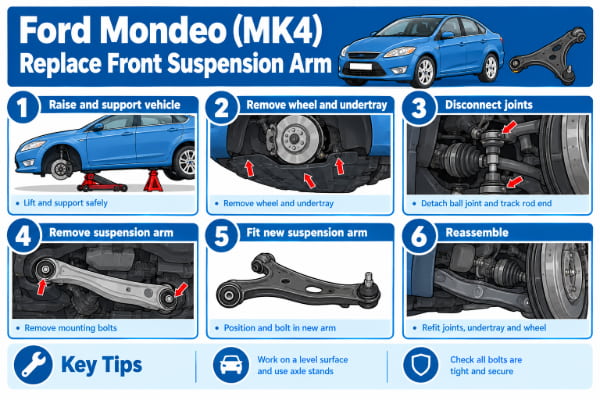
- Loosen the front wheel nuts, then raise and support the relevant corner of the car on axle stands. Remove the wheel.
- Remove the nut securing the outer ball joint to the hub/steering knuckle, and separate it using a ball joint separator.
- Remove the front and rear inner mounting bolts securing the arm to the subframe.
- Support the subframe area if any subframe fixings are disturbed, and check for any anti-roll bar link that may need disconnecting for clearance.
- Withdraw the old suspension arm from the car.
Installation procedure
- Offer the new arm into position and loosely fit the inner mounting bolts to the subframe by hand.
- Reconnect the outer ball joint to the hub/steering knuckle and fit a new nut, torquing to the figure in your Mondeo Mk4 workshop manual.
- With the suspension at approximate normal ride height (ideally with the car's weight on the wheels, not hanging free), torque the inner mounting bolts to spec — these bushes are designed to be tightened under load, not fully extended.
- Reconnect any anti-roll bar link disturbed during removal.
- Refit the wheel, lower the car, and torque the wheel nuts (commonly cited at 140 Nm — verify against your own handbook).
Final checks and road test
Before driving, check every disturbed fixing is torqued, not just snugged. Get the front wheel alignment checked afterwards — replacing a suspension arm changes the geometry slightly and can affect tracking even when the part is fitted correctly. On the first drive, listen for the original knock or clonk; it should be gone, and steering feel should be noticeably tighter.
Troubleshooting and tips
- Knock persists after replacement: recheck the opposite side — wear is often present on both arms even if only one was clearly failing.
- Steering feels off after the job: get an alignment check before assuming a fitting fault; geometry changes are normal after arm replacement.
- Ball joint separator won't release the joint: apply penetrating fluid and give it time — forcing it risks damaging the hub or knuckle.
Once torqued correctly and with the tracking checked, the front end of a Mk4 Mondeo should feel tight and quiet again — no clonks over bumps, no vague wander on the motorway. It's a job worth doing properly with a torque wrench rather than rushing the final tightening stage.
See also our guides to the Mondeo Mk4 front bumper and headlight exchange, or browse all Ford Mondeo guides and the Suspension category for more.