
Issues With Ford's 1Ltr Petrol Engine
Engine · Fiesta · Ford · Maintenance
The Ford 1.0-litre EcoBoost arrived with genuine fanfare. A three-cylinder engine producing the power of something twice its size, sipping fuel, winning awards, and fitting neatly into a Fiesta or Focus engine bay — it looked, on paper, like the small car engine Ford's customers had been waiting for.
Then the wet belt problem started making itself known.
If you're looking at a used 1.0 EcoBoost and you've stumbled across warnings on forums, or a mechanic has raised an eyebrow during a service, this article will give you the full picture. What the problem actually is, which engines are affected, what Ford has and hasn't fixed, and whether these cars are worth buying at all.
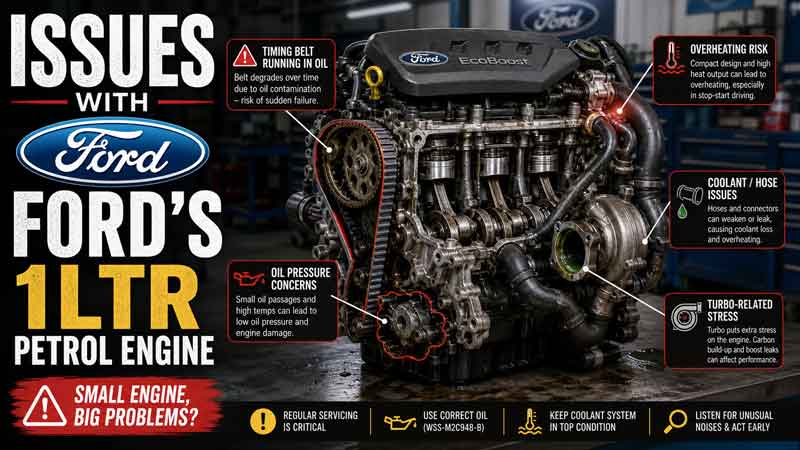
Grab a coffee, because we are going to break down everything you need to know about the Ford 1.0 EcoBoost engine issues, no mechanical engineering degree required.
The "Award-Winning" Elephant in the Room
To be fair to Ford, the 1.0-litre EcoBoost was a genuine engineering achievement when it launched. A turbocharged three-cylinder producing power that belied its displacement, it won the International Engine of the Year award for six consecutive years — no small feat in a competitive field.
It drives well, too. Around town it feels alert and responsive, and the fuel economy figures, when the car is driven sensibly, are genuinely impressive. The problem isn't what the engine produces. It's how Ford chose to build it.
The "Wet Belt" Problem (The Core Issue)
Let’s talk about the technical hiccup that has the National Highway Traffic Safety Administration (NHTSA) investigating this engine.
Most engines use a metal chain to keep the valves and pistons moving in sync, or a dry rubber belt. Ford decided to use a "wet belt." That means a rubber belt sits inside your engine, bathing in hot engine oil.
Why would they do that?
It reduces friction, which slightly boosts fuel economy. Sounds smart, right? Unfortunately, the reality has been messy.
Over time, and often sooner than expected, that rubber belt starts to degrade. It doesn't just snap (which is bad enough); it disintegrates into little rubber fragments. Those fragments float around in your oil, clog up the oil pump pickup tube, and starve the engine of lubrication .
The result? You’ll see a "Low Oil Pressure" light, and shortly after, you might need a whole new engine.
Comparison: How Ford Did It vs. The Competition
To understand why this is such a headache, let’s look at how Ford’s design stacks up against the "old school" way of doing things.
As you can see, while the belt design saves Ford a few bucks on manufacturing, it pushes a massive repair bill onto you, the owner.
The "Good News"? Ford Finally Fixed It (Sort of)
If you love the idea of a small, turbocharged Ford but want to sleep soundly at night, there is light at the end of the tunnel. Ford heard the complaints.
In newer models (roughly late 2020 onwards, especially the Mild Hybrid versions), Ford finally ditched the rubber timing belt for a timing chain .
But hold on. Before you rush out to buy a 2023 model, there is a fine print.
While the timing belt is now a chain (good!), the oil pump in these newer engines is still driven by a wet belt . It isn't under as much stress as the timing belt, but the fact remains: there is still rubber soaking in your oil. It’s better, but it isn’t perfect.
Real-World Implications: Should You Buy One?
If you're looking at a pre-2019 example, the honest advice is caution. The repair cost for a seized engine on these cars regularly exceeds the vehicle's market value, which makes a used 1.0 EcoBoost in poor health one of the riskier used car purchases in this price bracket. That's not scaremongering — it's a straightforward financial calculation.
If you already own one, or you've found a well-priced example with a full service history and recent belt inspection, you aren't automatically heading for trouble. But you do need to be rigorous about maintenance in a way that most modern cars simply don't demand.
Oil changes cannot be stretched. Regardless of what Ford's service schedule suggests, owners of these engines should be changing the oil every 5,000 to 7,000 miles. The correct specification oil matters too — this engine requires a specific low-friction grade to protect the belt, and cutting corners here accelerates degradation significantly. Around 60,000 miles, a specialist should inspect the belt's condition directly through the oil filler cap, before any external symptoms appear.
None of this is complicated. It's just non-negotiable.
The Verdict
The 1.0-litre EcoBoost is not a bad engine. It's a compromised one. The wet belt design made engineering sense in isolation — reduced friction, better efficiency, a smaller, lighter package — but it introduced a failure mode that is catastrophic rather than gradual, and expensive rather than manageable.
For 2022 models onwards with the timing chain update, the picture is considerably better. The oil pump belt remains, but the most dangerous single point of failure has been addressed. These are reasonable used car buys, provided the rest of the car stacks up.
For anything built before 2020, the calculation is straightforward: full service history, documented oil changes at short intervals, and ideally a recent belt inspection from someone who knows the engine. Without all three, walk away. There are enough of these cars on the market that you don't need to settle for one with a question mark hanging over it.